
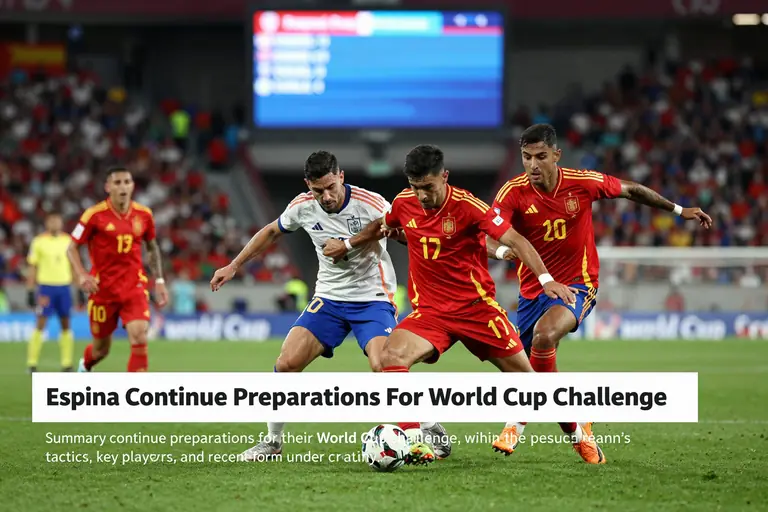
Current Situation: La Roja’s Road Ahead
As the next major international tournament approaches, Spain continue preparations for World Cup challenge, meticulously refining their squad and tactics. Under the guidance of coach Luis de la Fuente, the team is working hard to build on recent performances and address areas for improvement. Our site has been closely following their journey, providing insights into their training camps, friendly matches, and squad selections. The focus is clearly on integrating new talent with experienced veterans, aiming for a cohesive unit capable of competing at the highest level.
The Spanish national team has a rich history in major tournaments, and the expectations from fans are always high. De la Fuente’s task is to harness this passion and translate it into on-field success. The team’s recent form has shown glimpses of brilliance, mixed with moments that highlight the need for further tactical adjustments. We believe that understanding these dynamics is crucial for any fan looking to follow Spain’s progress.
Team Analysis: Strengths and Areas for Development
Spain’s traditional strength lies in their midfield control and intricate passing game, often referred to as “tiki-taka.” This style emphasizes possession, quick exchanges, and creating numerical advantages in central areas. Players like Rodri and Pedri are central to this philosophy, dictating the tempo and linking defense with attack. Their ability to retain possession under pressure and distribute the ball effectively will be vital in breaking down resilient defenses at the World Cup.
However, recent performances have also exposed certain areas that need attention. Finishing chances has sometimes been a concern, with the team creating numerous opportunities but not always converting them into goals. The coaching staff will undoubtedly be working on improving clinicality in front of goal, perhaps by exploring different attacking formations or encouraging more direct play when appropriate. Furthermore, while the defense is generally solid, dealing with rapid counter-attacks from pacey opposition wingers remains a tactical puzzle that needs solving. We’ve observed several instances where quick transitions have put the Spanish backline under considerable strain.
Player Watch: Key Figures to Monitor
A few players stand out as particularly crucial to Spain’s World Cup aspirations. Rodri, the Manchester City midfielder, is arguably the team’s most indispensable player. His defensive intelligence, ability to break up play, and exceptional passing range make him the anchor of the midfield. His presence allows more attacking midfielders to push forward with confidence.
Another player to keep a close eye on is Lamine Yamal. Despite his youth, Yamal has already demonstrated incredible skill, pace, and an eye for goal. His emergence provides Spain with a genuine threat on the wing, capable of beating defenders and creating chances. His integration into the starting XI or as a super-sub will be fascinating to observe. On the defensive end, Aymeric Laporte’s experience and leadership at the back will be essential, especially in high-pressure matches. His ability to organize the defense and his aerial prowess are significant assets.
The development of these players, alongside the consistent contributions of others like Dani Carvajal and Álvaro Morata, will largely determine Spain’s trajectory in the tournament. Injuries or loss of form for any of these key individuals could significantly impact the team’s overall balance and performance.
Tactical Overview: De la Fuente’s Approach
Luis de la Fuente has shown a willingness to adapt his tactical approach, though the core principles of possession-based football remain. He often favors a 4-3-3 formation, allowing for width in attack and numerical superiority in midfield. However, he has also experimented with variations, sometimes shifting to a 4-2-3-1 to provide more defensive cover or to accommodate an attacking midfielder in a central role.
A key aspect of his strategy is the emphasis on high pressing. When possession is lost, the team aims to win the ball back quickly in advanced areas, disrupting the opponent’s build-up and creating immediate scoring opportunities. This aggressive defensive posture requires high levels of fitness and coordination from all players. We anticipate that de la Fuente will continue to fine-tune these tactical elements as the World Cup draws nearer, seeking the perfect balance between offensive flair and defensive solidity.
Historical Context: Lessons from Past Campaigns
Spain’s World Cup history is a mix of triumph and disappointment. Their glorious victory in 2010 showcased the pinnacle of their “tiki-taka” era, demonstrating how a dominant possession game could lead to ultimate success. However, subsequent tournaments have highlighted the challenges of maintaining that dominance and adapting to evolving football trends.
The early exits in 2014 and 2018 served as stark reminders that relying solely on one style of play can make a team predictable. The team’s performance in 2022, though showing moments of quality, ultimately ended in a penalty shootout defeat, underscoring the fine margins at this level. These past experiences will undoubtedly inform the current preparations. The coaching staff will be keen to ensure that while Spain retains its unique identity, it also possesses the tactical flexibility and mental resilience to navigate the pressures of a World Cup knockout stage. Learning from these historical outcomes is a vital part of how Spain continue preparations for World Cup challenge, aiming to write a new, successful chapter.
FAQ
Q: Who is the current coach of the Spanish national football team?
A: The current coach of the Spanish national football team is Luis de la Fuente.
Q: What is Spain’s traditional playing style?
A: Spain’s traditional playing style is often referred to as “tiki-taka,” characterized by short passing, possession retention, and intricate build-up play.
Q: Which Spanish player is considered a key midfielder for the upcoming World Cup?
A: Rodri, the Manchester City defensive midfielder, is considered a key figure for Spain due to his defensive intelligence and exceptional passing range.